
Blog
Registered NDIS Provider: What It Actually Means, and Why It Matters

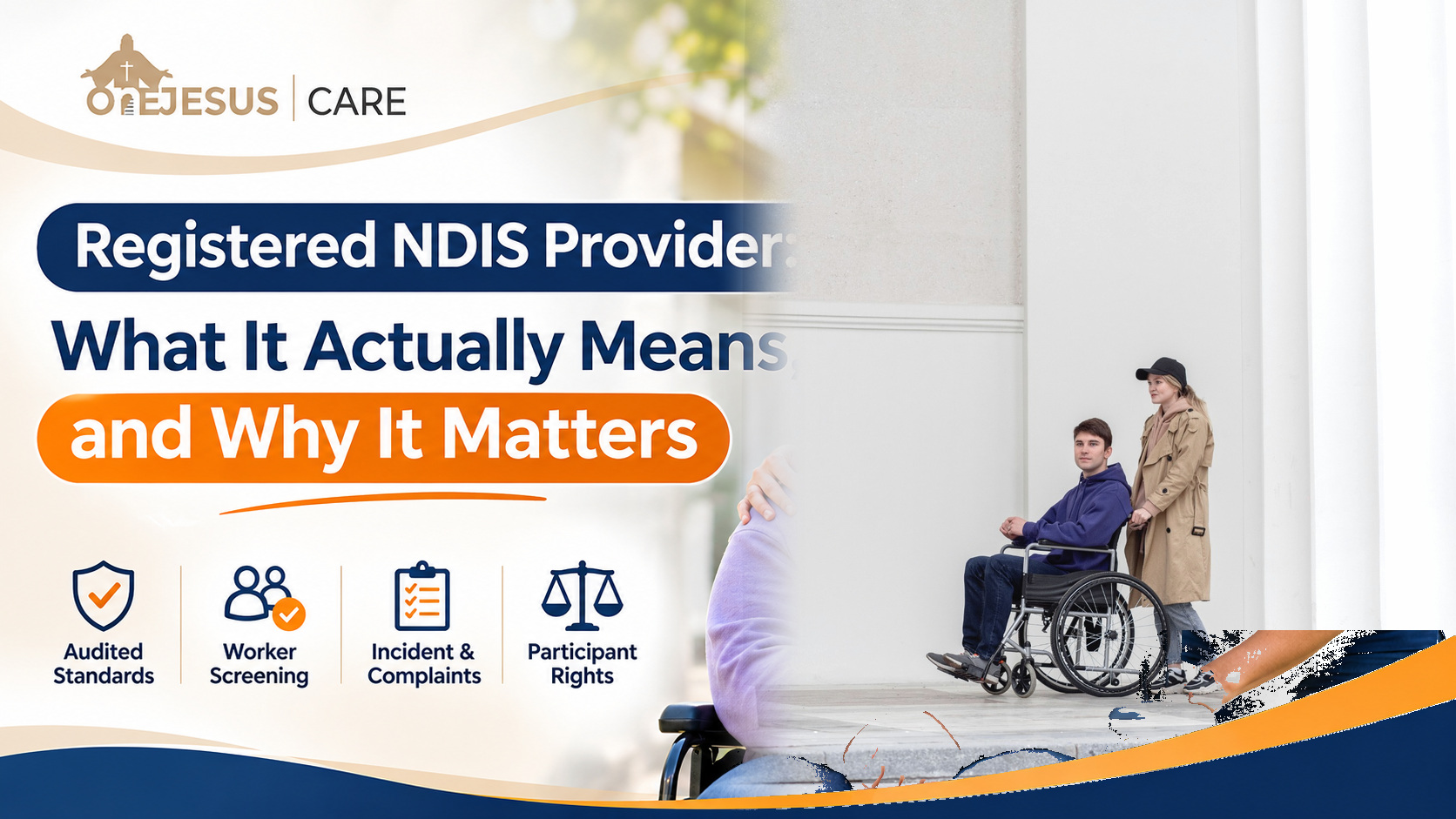
If you have started looking for disability support, you have seen the word registered attached to some providers and not others. It is easy to read it as a formality. It is not. Registration decides who can audit a provider, what standards they are held to, and what happens when something goes wrong.
It also matters more than it used to. From 1 July 2026, providers delivering supported independent living must be registered with the NDIS Quality and Safeguards Commission. For the supports where someone is in a participant's home every day, registration is no longer optional.
Here is what registration actually involves, where it matters most, and how to check any provider yourself in about two minutes.
What registration actually means
A registered NDIS provider has been approved by the NDIS Quality and Safeguards Commission, the independent body that regulates disability services in Australia. Registration is not a form. It involves an audit against the NDIS Practice Standards by an approved quality auditor, and it has to be renewed.
The audit looks at the things you cannot see from the outside.
- Worker screening. Every worker in a risk assessed role holds a current NDIS Worker Screening Check.
- Incident management. There is a documented process for reporting, recording and responding to incidents, and certain serious incidents must be reported to the Commission.
- Complaints. There is a complaints process a participant can use, and the Commission can be approached directly if the provider does not resolve it.
- Governance and risk. Someone is accountable, in writing, for safety and quality.
- Participant rights. Choice, dignity, privacy and freedom from restrictive practice are built into how supports are delivered.
None of this makes a provider perfect. It does mean there is an external body that can inspect, require changes and, in serious cases, remove a provider's registration.
What changed on 1 July 2026
Registration used to be largely a choice for providers outside the agency managed system. That has been narrowing. From 1 July 2026, providers delivering supported independent living and NDIS digital platforms are required to be registered. Mandatory registration for support coordination was paused for further consideration rather than introduced alongside it.
The practical effect for a family is simple. If you are looking at supported accommodation, registration is not a point of difference any more. It is the baseline, and a provider offering that support without it is a question worth asking about directly.
Unregistered providers are still legitimate
This gets misrepresented, so it is worth saying plainly. Outside the supports now covered by mandatory registration, unregistered providers are not operating illegally. Many are small, excellent and highly personal services, and some participants choose them deliberately.
What differs is oversight and access. A registered provider is audited against the Practice Standards. An unregistered one is not. And how your plan is managed affects which providers you can use at all, which is a conversation to have with your plan manager or support coordinator rather than with an article.
Where registration matters most
For a support that is occasional, low risk and easily changed, registration is one factor among several. For supports where someone is in your home daily, assists with personal care, handles medication or provides accommodation, the gap between audited and not audited is significant.
- Supported independent living and group homes, where support is daily and ongoing
- Personal care and assistance with daily living
- Short term respite, where someone stays away from home
- Any support involving medication, restrictive practices or high intensity needs
How to check a provider in two minutes
You do not need to take anyone's word for it, including ours.
- Ask for the registration number. A registered provider has one and will give it without hesitation.
- Check it against the Commission's register. The NDIS Commission publishes a list of registered providers you can search.
- Ask which registration groups they hold. Registration is granted for specific types of support, not as a blanket approval. A provider can be registered for one support and not another.
- Ask when they were last audited, and whether any conditions sit on their registration.
- Ask for the complaints process in writing. A provider comfortable with oversight hands it over straight away.
A provider who becomes vague at any of those five questions has told you something useful.
Where OneJesus Care sits
OneJesus Care is a registered NDIS provider, registration number 4050084117, operating from a head office at 32 Box Road, Wakeley, and supporting participants across Western Sydney. We are a Christian, not for profit organisation, and we support people of all faiths and of none. Faith is why the organisation exists. It has never been a condition of receiving support.
What to Do Right Now
- Ask every provider on your shortlist for their registration number. Write it down.
- Check each one against the NDIS Commission's register of registered providers. It takes a minute per provider.
- If you are looking at supported independent living, treat registration as mandatory, because since 1 July 2026 it is.
- Ask which registration groups they hold, not just whether they are registered. The two are not the same question.
- Ask for the complaints process in writing before you sign anything.
Frequently Asked Questions
Q: Can I use a provider that is not registered?
For most supports it depends on how your plan is managed. Since 1 July 2026, supported independent living providers must be registered. Your plan manager, support coordinator or the NDIS can confirm what applies to your plan right now.
Q: Does registration mean the support will be better?
No. It means there is independent oversight of safety and quality. The quality of the day to day relationship still comes down to the people who turn up, which is why it is worth meeting a provider before committing.
Q: How do I check whether a provider is registered?
Ask for their registration number, then search the register of registered providers published by the NDIS Quality and Safeguards Commission. A provider who will not give you the number is answering the question another way.
Q: What is the NDIS Quality and Safeguards Commission?
It is the independent body that regulates NDIS providers and workers. It registers providers, audits them against the NDIS Practice Standards, enforces the NDIS Code of Conduct and handles complaints about providers and workers.
Q: Can I change provider if it is not working?
Yes. The notice period will be set out in your service agreement, and a good provider will help with the handover rather than make it difficult.
Related Reading
- Supported Independent Living Explained, what SIL covers, and the supports now requiring registration.
- Support Coordination and Plan Management, how your plan is managed affects which providers you can use.
- NDIS Day Programs and Community Participation, what day programs and community participation funding cover, and how to choose one.
- Contact OneJesus Care, to ask any of the five questions above.